Current Issue: Volume 21.1
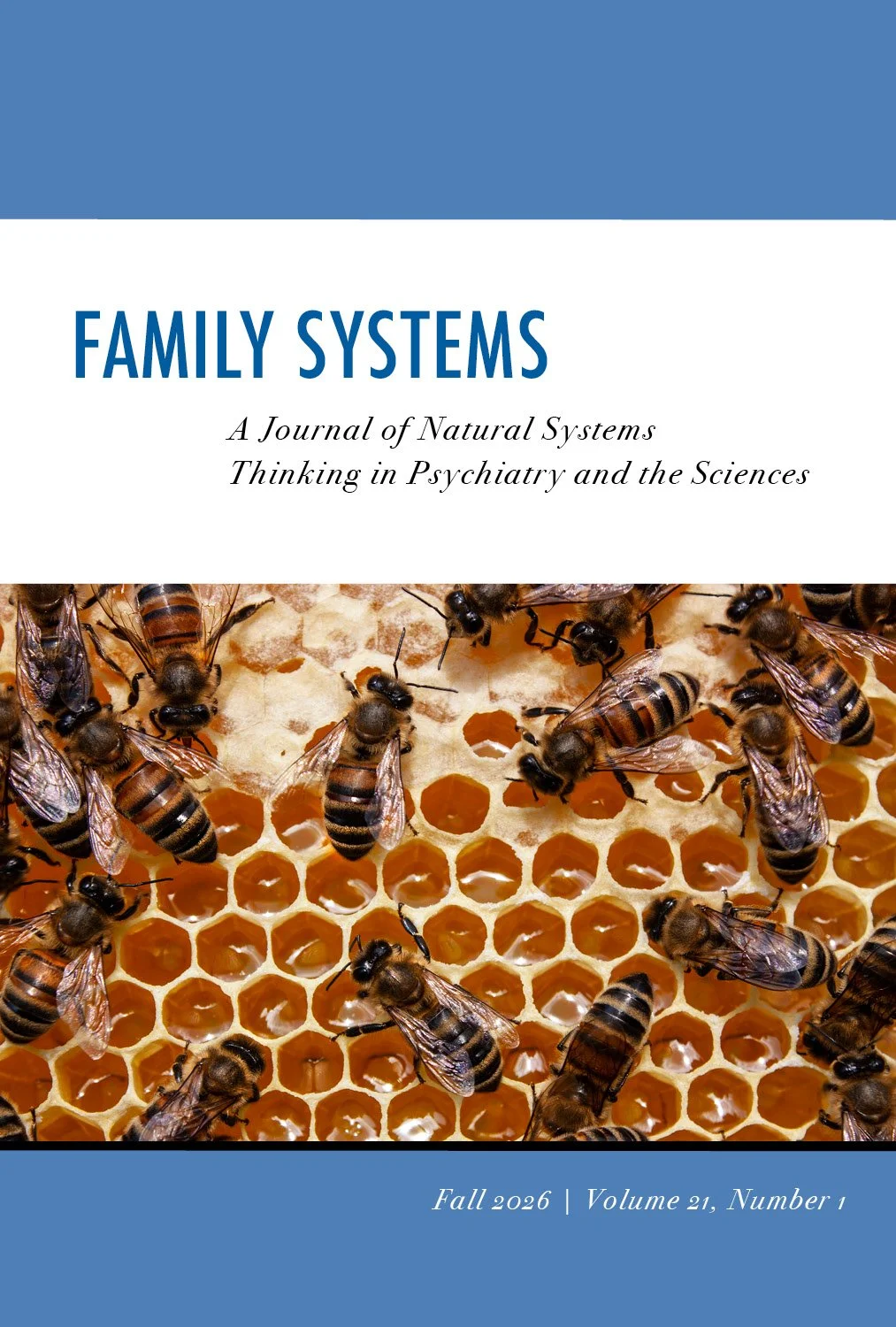
Begin your subscription with 21.1
Volume 21.1 goes to press this fall. Use the buttons below to subscribe.
Institutional Subscribers: Both subscription categories below provide an institutional option for you to select.
Subscriptions beginning with Volume 20.2 are still available. Visit the 20.2 webpage to learn more and subscribe.
For more information on the journal, visit the website’s main journal page.
Full back issues and individual articles are also available at this link.
For updates, please subscribe to our newsletter.
FROM THE EDITOR:
Robert J. Noone, PhD
ARTICLES: Journal articles reflect natural systems thinking or are relevant to it. These may include concept papers as well as research studies.
THE GLUE THAT HOLDS PEOPLE TOGETHER: A THEORETICAL UPDATE
Margaret Donley, MSW
This paper explores Murray Bowen’s question, “What is the glue that holds people together?” by examining the biological foundations of emotional connection. While attachment theory remains the dominant framework for understanding early development, its primary emphasis has been on observable postnatal behavior and the individual child. Less attention has been given to the physiological processes underlying connection, particularly those beginning in utero. Bowen family systems theory, through its construct of the emotional system, may be better positioned to integrate advances in neuroscience and developmental biology. Drawing on the work of Hofer, Meaney, and Welch, the paper argues that early caregiving operates through biological mechanisms, including hidden physiological regulators, epigenetic embedding, and autonomic co-regulation beginning in utero. Central to this process is functional Pavlovian conditioning, an ancient form of learning through which emotional connection becomes biologically embedded in the autonomic nervous system. Over time, repeated interactions give rise to automatic physiological responses to specific others — responses that operate largely outside conscious awareness. From this perspective, emotional connection is grounded in evolutionarily conserved autonomic processes that extend beyond the dyad to the family as an emotional unit.
BEYOND ILLNESS PERCEPTION: THE PATIENT-FAMILY-CLINICIAN SYSTEM IN CHRONIC ILLNESS
Dawn Shepard, DNP, PMHNP-BC
Chronic illness sometimes gives rise to a clinical pattern in which a patient’s functioning narrows in ways that exceed what disease pathology alone[PW1] explains. An earlier concept analysis by the author named this pattern self-fulfillment in illness perception and framed it as a self-fulfilling prophecy located in the patient’s perception of illness. The present paper revisits that concept through Bowen family systems theory and reconsiders it as a systems-level phenomenon. Narrowed illness functioning is reframed as the visible outcome of a recursive emotional process in which chronic anxiety in the patient, family, and clinical relationship system becomes bound through illness. Two contrasting composite illustrations show how reciprocal overfunctioning and underfunctioning, fusion, and clinician anxiety shape symptom course. Implications follow for psychiatric mental health nurse practitioner practice and for psychotherapy education.
Keywords: Bowen family systems theory, chronic illness, chronic anxiety, differentiation, overfunctioning, underfunctioning, fusion, triangulation, sick role, self-fulfilling prophecy, psychiatric mental health nursing, psychotherapy education
BRIEF REPORT: Brief reports present important ideas in development and promising research in its early stages.
PARTICIPATION IN A BOWEN THEORY GROUP
Berit Sundgren Grinups
Bowen’s family systems theory provides a framework for understanding how individuals are shaped within their family systems and how increased awareness of oneself and one’s multigenerational family context can enhance individual and systemic functioning. In Bowen groups, participants explore family patterns with a coach using family diagrams and reflective dialogue.
A survey study of 16 participants demonstrated clear effects. Longer participation was associated with greater improvements in functioning, independent of age. Early gains included clearer thinking, better decision-making, and improved friendships. Over time, participants reported increased emotional objectivity, greater calmness under stress, stronger family relationships, and enhanced leadership and parenting capacity. They described adopting a systems perspective, shifting from individual blame to viewing problems within a broader emotional system. Increased awareness of inherited relational strategies reduced emotional reactivity and strengthened differentiation of self. The structured group format supported responsibility and self-focus. Overall, participation fostered cumulative and lasting personal and relational change.
FACULTY CASE CONFERENCE: Presentation of a faculty clinical case, followed by a discussion with faculty members of the Bowen Center.
Presenter: Jake Morrill, MDiv
BOOK REVIEW: Reviews on books relevant to Bowen theory and its many applications.
The Evolution of Agency: Behavioral Organization From Lizards To Humans
by Michael Tomasello
Reviewed by Daniel V. Papero, PhD, LCSW